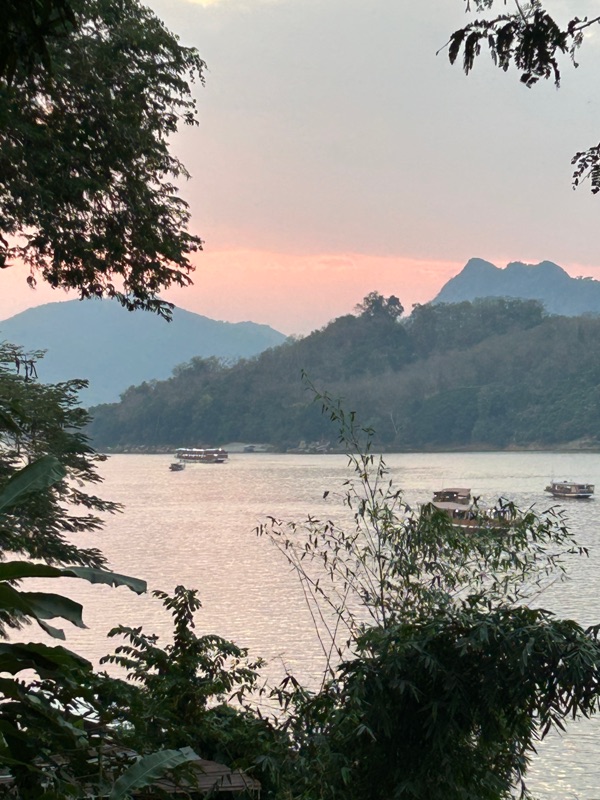
Luang Prabang, Laos
I’ve settled-in nicely here in Luang Prabang, former Royal capital of Laos.
As much as I had heard about and was attracted to Luang Prabang, at first blush I was put off by the tourism. But so goes the world, sigh, and I have to own up to the fact that I’m part of it.
There aren’t so many Westerners here; mostly from Europe, very few from the US. But mostly Laotians and Chinese who travel in large groups and are quite loud. I don’t particularly like stereotypes; they have danger and prejudice written all over them. But find most of them have an element of some truth.
I had heard and have now experienced that the cultures of SE Asia are noticeably quiet. Conversations, even exclamatory remarks, have a certain quiet restraint, as if silence is as golden as the many statues of Buddha are prevalent.
I ponder whether all people from so-called developed countries, the US and China, Russia are loud with hubris, taking up more than their allotted space? In any case, it becomes loud to the point of funny when a Chinese family or group walks into a restaurant or other public space. Especially the men; it’s as if they’re shouting.
But that’s an aside that I may delete before posting, an odd ripple in this pond of peaceful beauty.
The largess of staying in a place rather than simply passing through allows time to explore the alleyways, the real and metaphorical ones, find the sweet spots, meet lovely people like sections of the mandarin fruit and lychees that are ubiquitous here.
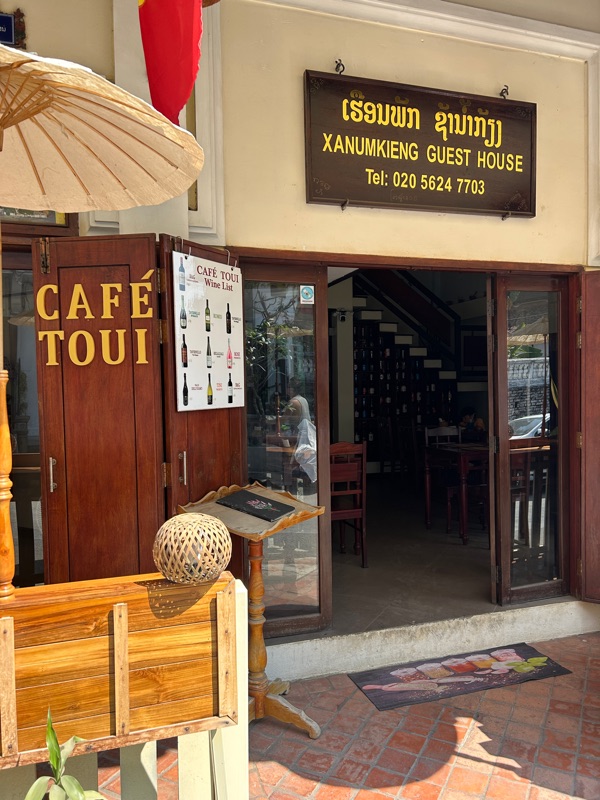
And I couldn’t have landed at a better home away from home than the Xanunkieng Guest House and Cafe Toui. Owner-chef Toui, his wife, Mon, and 7-year-old son, Nava, have become like family. I believe I mentioned previously that an Aussie woman, Sue, who I met here, has been coming annually for years, and she truly is like family. And we got along from the get-go, which was my way in.
Also, Sylvan, a Vietnamese man about my age, whose family was exiled to Luang Prabang, where he met the US ambassador’s daughter, married, and moved to the US when the communists overthrew the monarchy in 1975. Since Sue left, I’m getting to know him better, and his story, which I’ll share another time.
—
I’ve previously mentioned how I gravitate to street life rather than museums. I dabble in the history of a place for perspective, but street life is the proof of the pudding. In particular, traveling in communist countries is curious because, for the most part, one would never know. Wherever one goes, life seems much the same, or so it seems. There are babies and lively markets and nods toward religion and hand-holding lovers and the elderly and frail. Life goes on.
I’ve taken to reading the weekly “China Daily,” and I marvel how the news and communist perspective is opposite to much so-called democratic philosophy we feign to hold dear in the United States. Even the term capitalism no longer fits. Wherever you go, it’s a rigged game, a see-saw of beliefs that always favors the elites. But life goes on…

Lao Friends Hospital for Children
Today, I stopped into The Blue House, a retail crafts and textile shop that helps support the Lao Friends Hospital for Children.
The NGO (charitable) sector in Laos, as in most underdeveloped countries, is a godsend and lifesaver. There is usually a link to a Western founder and NGO, and the integral services of this hospital - the only pediatric hospital in Laos - are astounding.
Big Brother Mouse
bigbrothermouse.com/luangprabang/englishpractice.html
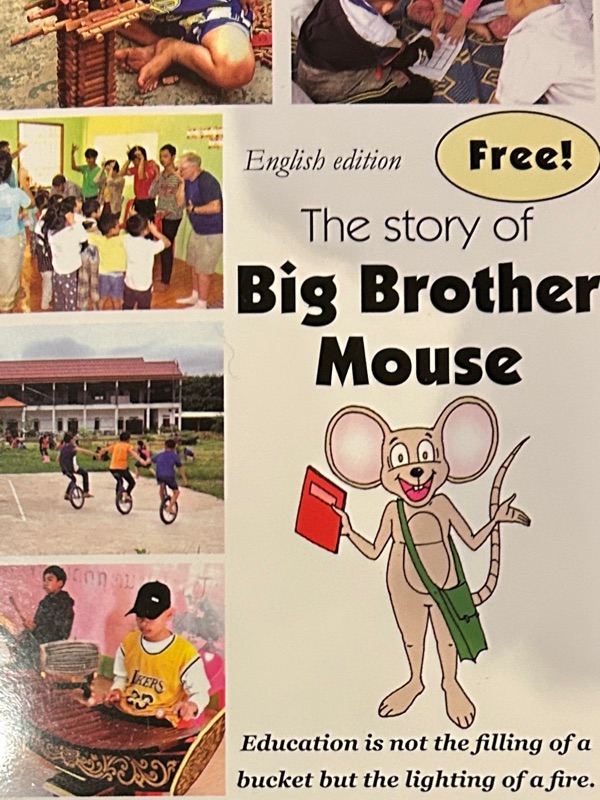
My second time at Big Brother Mouse was as wonderful as the first! A brilliant idea and a precious opportunity. First was a young Hmong man, Mi, a senior in high school. There are three primary people in Laos: the Lao, Hmong, and Ahka. They all sprawl across borders into Thailand, Myanmar and Vietnam. As everywhere, tribes spread according to resources; the Western colonial powers drew lines. Mi had to leave at 6 to pick up his younger sister, and soon a 19-year-old Buddhist novice took his place. Boy, did we have a good time! He had a lovely way about him, an easy smile. I didn’t get his name; everyone I meet has a two-letter nickname to make it easier on Westerners. For instance, my trusted guide to the caves and waterfalls that I’ll introduce later is “Ki,” otherwise known as Bounma Onmany.
So I’ll call my monk conversation partner “Li”, for lack of remembering. Li’s parents died when he was young; he doesn’t remember his father. He has 5 siblings (most of the young people I’ve met have large families, and I’m quick to offer that I’m one of six). Li and two brothers went to live in a monastery, where they received an education. I’ve learned that many/most villages don’t have a school; others only go to the 5th grade. So the monastery is the thing, a privilege.
For the girls, it’s the orphanage where his sisters live. He only spoke of one, who I understood lives nearby his monastery. He sees her on holidays and festivals and says she is lucky and happy.
Li says he’s not going to become a monk. He wants to go to the university and work in tourism. Our time was up, and two other monks joined us as we wrapped up our conversation. One thought they recognized me, a “rock star from America.” This happens a fair amount in my travels, as it did in India and Nepal last year. My long hair is seemingly the giveaway.
—
KhaiphaenAmong my backstreet wandering, I was delighted to come across the Khaiphaen restaurant. An initiative of the Tree Alliance, which is sponsored by Friends International. With its “East meets West” mission and menu, it is a vocational training school for underprivileged youths who aspire to work in the hospitality industry. The golden pumpkin curry was creamy and lovely, and the young woman trainee a tender and tentative sweetheart.
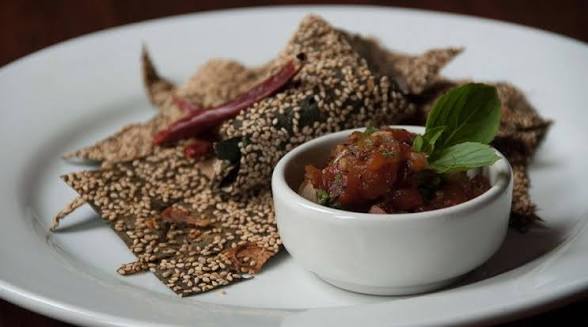
* Khaipean is also the name Laotian dish that refers to the wild river weed that grows along the Mekong River. It's a staple dish, a cracker topped with sesame seeds, often served with a garlic and tomato chutney.
—
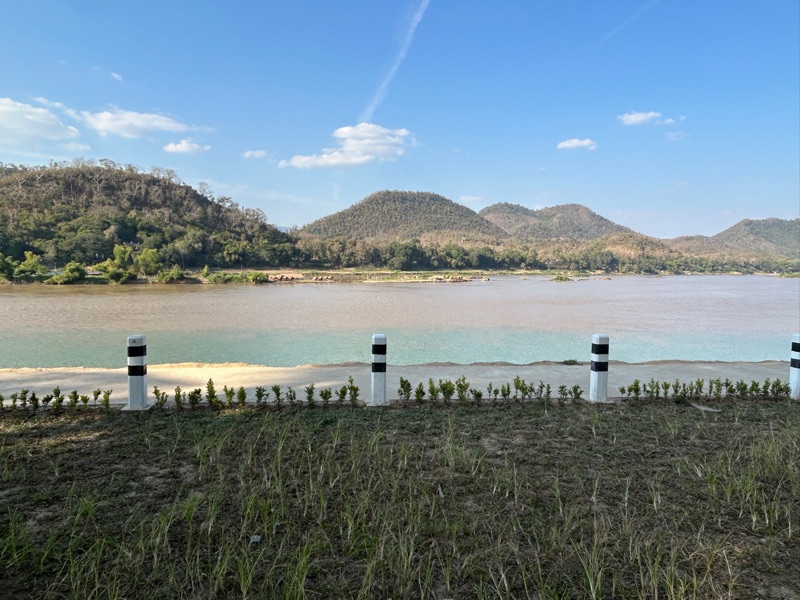
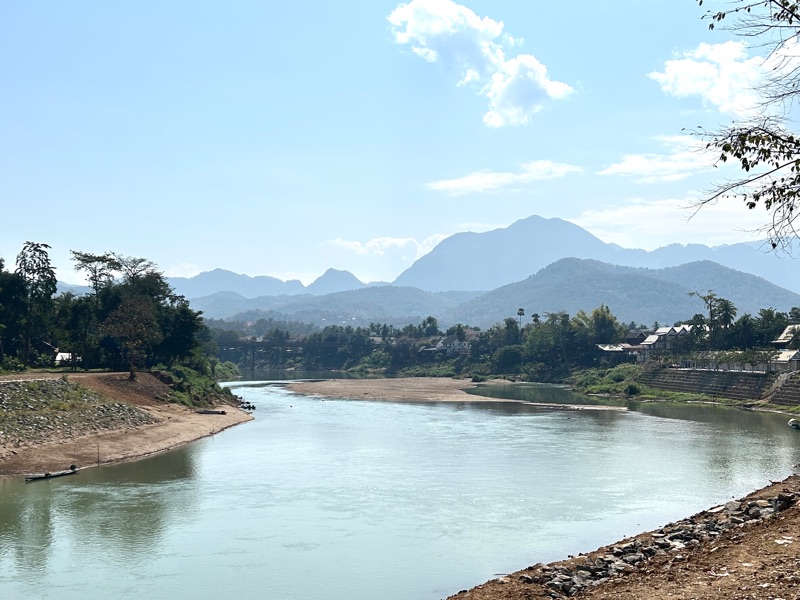
Mekong Riverside